Vanessa Salles · RTT® Practitioner
Train How to Act
Instead of React
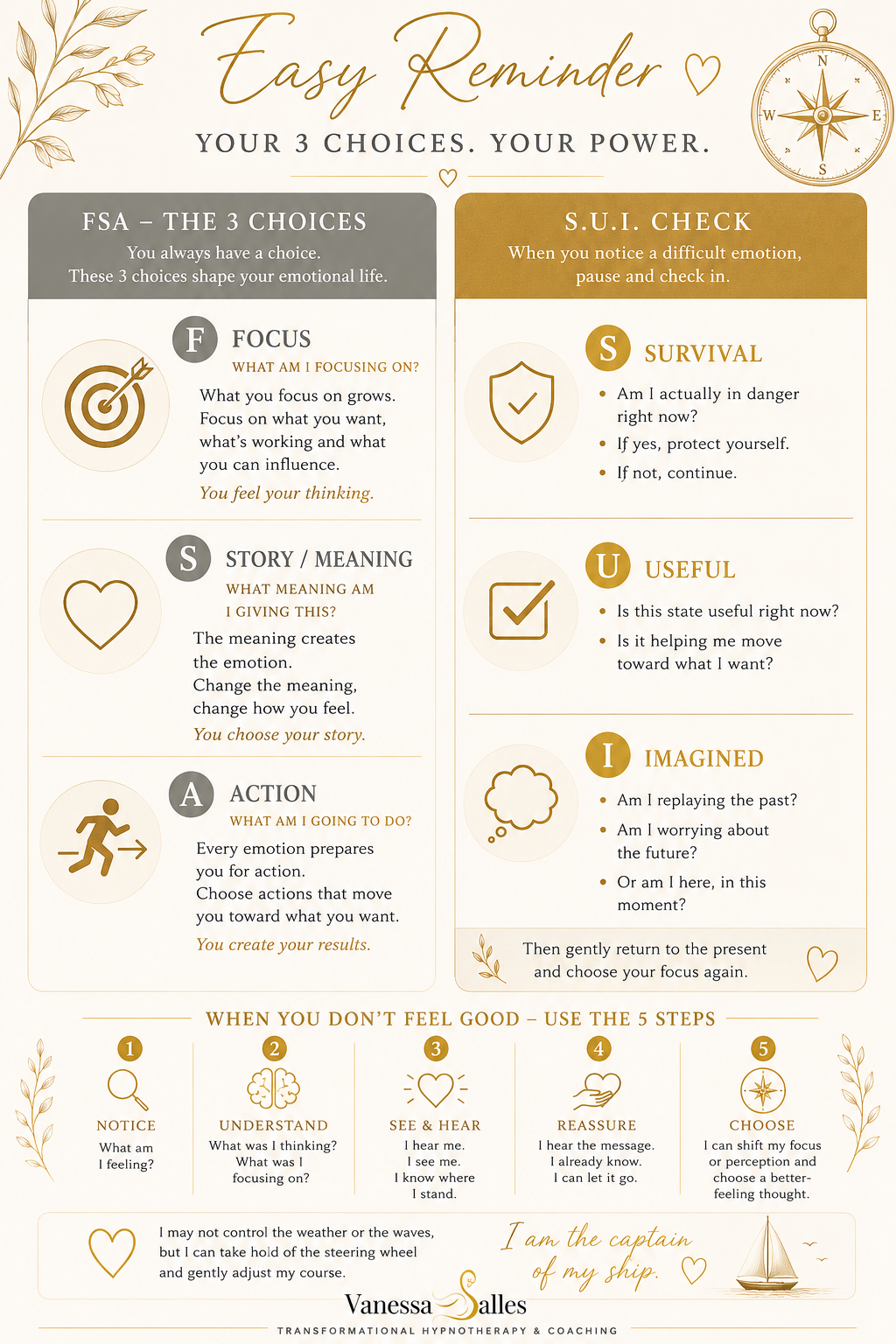
The Three Choices That Shape Your Emotional Life
At a Glance
Choice One · Focus
What am I focusing on?
You feel what you think. Wanted or unwanted — your focus creates your emotional state.
Choice Two · Meaning
What meaning am I giving this?
It is never the event. It is the story you attach to it. Change the meaning — change the emotion.
Choice Three · Action
What am I going to do?
Emotions prepare us for action. The state you are in shapes everything that follows.
A second framework — your emergency stop
The S.U.I. — three words to stop your automatic response
When you enter a negative state, pause and ask:
- S — Survival · Am I in survival mode? Is my life actually in danger?
- U — Useful · Is this state useful right now?
- I — Imagined · Is this imagined? Am I in the past or the future?
If not — return to the present and consciously choose your focus.
Everything we do — or don't do — is because we expect to feel a certain way.
Let's talk about a human capacity we often take for granted — like a muscle we've never consciously trained.
Focus.
Most of us use it on autopilot. But when you start using it consciously — you can get great results, faster.
And here's the thing: focus and feeling go hand in hand. We focus in order to experience something. To feel something — or to avoid feeling something.
Our feelings are like the cherry on the cake of every experience. Without them, an experience feels flat. Uninteresting. Boring. Not worthwhile.
But here's the thing: this process happens unconsciously, most of the time. And many people end up feeling bad — living non-preferable states and emotions.
If you often feel stress, frustration, anxiety or sadness — and unfortunately, these emotions even come to feel familiar, for some even normal — then what follows is for you.
Most of us live on autopilot.
We react.
We think our emotions are caused by life, by circumstances or by other people.
But our emotional experience is not random.
It is shaped by patterns.
Patterns of focus. Patterns of meaning. Patterns of behaviour.
And the beautiful thing is that these patterns can change.
Because all day long, we are making three choices — usually without even realising it:
- Where am I placing my focus?
- What meaning am I giving this?
- What am I going to do next?
These three choices shape our emotional experience and ultimately the quality of our lives.
Two tools to help you create a different experience
The FMA — Focus · Meaning · Action : a framework to understand and shift your emotional patterns
The S.U.I. — Survival · Useful · Imagined : your emergency stop when you enter a negative state
Transformation begins when these choices become conscious.

Choice One
What Am I Focusing On?
Focus — our brain's ability to zoom in on what matters — is one of its most powerful qualities. It enables us to survive, to be effective, and even to create the life we desire. Focus is a human quality that can be trained.
Most people focus by default. Not because they can't do better — but simply because they were never taught how.
Your brain's ability to focus can be compared to using a search engine. You tell it what you want to see — and it crawls, filters, and brings back evidence that matches your focus.
Focus on danger and it will find reasons to worry.
Focus on problems and it will find more problems.
Focus on possibilities and it will notice opportunities.
We focus. This generates thoughts. And every thought has an emotional echo — your emotions are like a translation into body language of your mental words and images.
You cannot focus on what you don't want and feel good.
You cannot focus on the problem and feel the solution.
You cannot think bad and feel good.
Habitual Focus
Just like any other habit, our focus — over time — becomes familiar, natural, normal, habitual.
When asked in seminars with thousands of people, most participants — over 95% — could identify at least one of these two patterns:
The first: focusing on what you don't want, on lack.
The second: focusing on what you can't control.
Both are patterns originally designed to enhance survival. Our brain has several parts brilliantly equipped to spot danger, anticipate threats, and keep us safe. This is not a flaw — it is a feature. It kept us alive. The challenge is that in everyday life, this same system fires for emails, traffic jams, and difficult conversations.
And so — if your feeling is the echo of your thinking, and your thinking derives from what you perceive — looking at what you perceive would be a great place to start.
So if you feel bad, I invite you to ask yourself this question:
Am I focusing on what I don't prefer, don't like, lack... the unwanted?
Or am I focusing on what I can't control?
If the answer is yes — great. You have just made a big step towards freedom.
Two common focus patterns that create a lot of suffering
Because think about it. If I focus on everything I don't want and everything I can't control — how could I possibly feel good? I can't. It is simply logical. My thoughts and my emotions are always aligned. I feel my thinking.
Unwanted Focus
- What I don't want
- What's wrong
- The problem
- What is missing
- What I can't control
→ creates stress, fear, frustration and powerlessness
Wanted Focus
- What I want
- What is working
- The solution
- What I appreciate
- What I can influence
→ creates hope, gratitude, energy and resourcefulness
Nothing changes outside of you. But your internal state changes completely. And that state will influence what you do next.
Whenever you don't feel good, ask yourself: Am I focusing on something I don't want? Am I focusing on something I can't control?
If yes — your emotional state suddenly makes perfect sense. And you can consciously choose a different focus.
When you don't feel good — don't fight the emotion
Your emotions are information. They are showing you what you have been thinking about.
Emotions are information, not instructions. Just because you feel something doesn't mean you have to act on it. You can listen, understand, and then choose consciously.
Step 1
Notice the emotion
Pause. Ask yourself: what am I feeling right now? Simply name it. Awareness is the beginning of choice.
Step 2
Understand why it makes sense
Ask: what was I just thinking? What was I focusing on? If you were focusing on what you don't want, on loss, on what you can't control — of course you feel this way. You are not broken. The emotion makes sense.
Step 3
See and hear yourself
Say to yourself: "I understand why I feel this way. I hear you. I see you."
One of the most powerful things we can learn is to become the person who sees and hears ourselves. To become our own safe place. Something often softens the moment we stop arguing with ourselves.
Step 4
Reassure yourself
This feeling is showing you what you don't want. What matters to you. What is not aligned with who you are.
"I know my position. I validate my position. I allow and accept my position. I know where I stand.
And because I know where I stand — I can return to it whenever I need. And I can walk away from it without losing a part of myself.
I don't have to stay angry to make my point. I don't have to keep suffering to show that I was right. I heard the message. I already know. I am ready to choose."
Step 5
Choose consciously
This is not about denying what you feel. It is about understanding where the feeling came from — and then consciously choosing a different focus, a different angle, a different energy.
Because your focus is crucial — it creates the e-motion. Energy in motion. The energy you bring into everything that follows.
If you want to move forward, you need a driving energy. If you want to stay safe, your system will choose one that slows you down. This is the hidden power that lives behind every focus choice.
Because the state you are in will influence what you do next, the decisions you make, and ultimately the experiences you create.
If you want more joy — be present. If you want to create — look forward.
A fulfilling life needs both. Living in the past keeps you stuck. The present-future balance is what creates a life that is fulfilling today and meaningful tomorrow.
Which brings us to the second choice — and its hidden power.

Choice Two
What Meaning Am I Giving This?
The moment something happens, we automatically give it a meaning.
The event is often the same. The meaning is different. And the meaning creates the emotion.
Change the meaning — and you change how you feel.
It is rarely the event itself that creates our emotions. It is the story we attach to the event.
Same glass. Completely different experience.
Imagine you are invited by a friend — to a restaurant, or somewhere special. You sit down, looking forward to the evening. And someone places a simple glass of tap water in front of you. Plain water. Boring. Not what you had in mind at all.
Now imagine you have been walking in intense heat for an hour. You are extremely thirsty. Someone hands you that exact same glass.
Suddenly: "This is exactly what I needed. Perfect."
Nothing changed. Same glass. Same water. But the meaning changed entirely — and so did the experience.
The meaning you give shapes everything.
And here is something Tony Robbins observed about relationships. In the beginning, your focus is on giving — what can I do for you? You are not measuring. That creates connection and love.
But somewhere along the way, you start measuring what you are getting. And the moment you start measuring, it becomes a transaction. Transactions don't make anyone feel good long term.
The meaning changed — and with it, everything else.
The meanings you carry today are not fixed. You can ask:
- What else could this mean?
- Is there another perspective?
- Is there a more empowering interpretation available to me?
Because the stories we tell ourselves shape the way we feel. And the way we feel shapes the way we live.

Choice Three
What Am I Going To Do?
Every emotion prepares us for action. It gives us a direction and an amount of energy.
Same situation. Different story. Completely different actions.
Emotions are information, not instructions. Just because you feel something doesn't mean you have to act on it. You can listen, understand — and then choose.
Your future self as a compass
If you want to know what to do differently — close your eyes for a moment.
Imagine a future version of you who already has, or already is, what you deeply desire. See them clearly. How do they carry themselves? What do they think? How do they respond to challenges?
Notice the gap between where you are now and where they are. That gap is not a problem — it is information. It is showing you exactly what to think differently, feel differently, and do differently.
Your future self is not a fantasy. They are a living blueprint. You don't have to figure it all out. You just have to follow the compass.
The S.U.I. Check
When you notice yourself entering a negative state, pause and ask:
S — Survival
Am I actually in danger right now?
If yes — protect yourself. If not — take a breath and continue.
Notice if something shifts, even slightly. Does your body feel a little less tense?
U — Useful
Is this state useful right now?
Is it helping me think clearly? Is it bringing me closer to what I want? If not — continue.
Is the intensity already a little different from when you started?
I — Imagined
Is this imagined?
Am I replaying the past? Am I worrying about a future that hasn't happened yet? If yes — gently come back to this moment. Then consciously choose your focus again.
Come back to right now. Notice what is actually here — not what your mind was creating.
A Daily Practice
Whenever you feel stressed, frustrated or overwhelmed, pause and ask yourself:
- What am I feeling?
- What am I focusing on?
- Am I focusing on something I don't want, or can't control?
- What meaning am I giving this?
- What action is this state preparing me to take?
- Is this where I want to go?
You are the captain of your ship. You may not control the weather or the waves, but you can take hold of the steering wheel and gently adjust your course.— Vanessa Salles
In summary
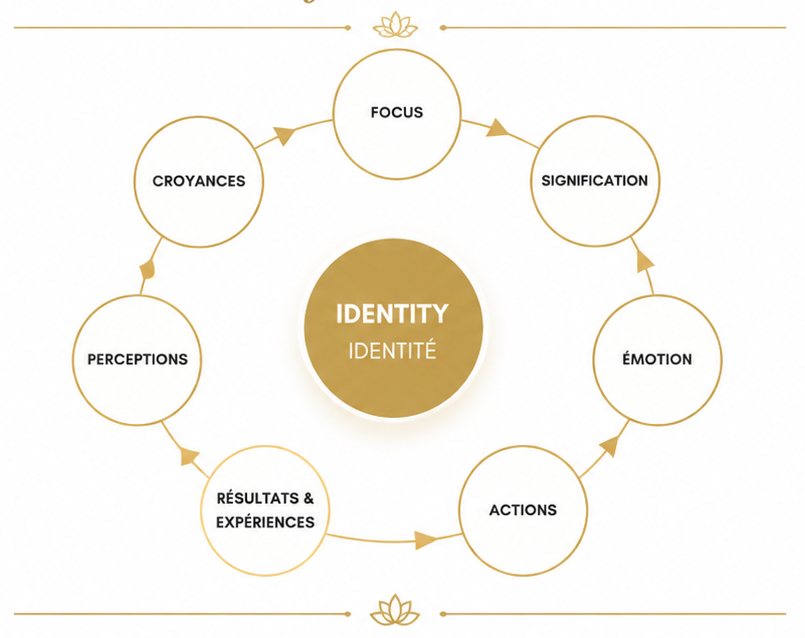
Focus → Meaning → Emotion → Action → Results → Experiences → Perceptions → Beliefs → Focus
What we focus on shapes how we feel. The meaning we give creates our emotions. Our emotions influence our actions. Our actions create our experiences. And our experiences shape who we believe we are.
Transformation happens when we become conscious of these patterns and start choosing them deliberately.
One conscious choice at a time. This is how we stop reacting and begin acting.
Every difficult moment is a practice moment.
Not a problem to escape. Not a sign that something is wrong.
An opportunity to pause. To understand yourself. To see and hear yourself.
And then to choose differently.
This is how you train.